Steve Herberman Diminished Resolutions Part 1
In this column we’ll be looking at symmetrical chordal patterns that form authentic cadences. This tension release formula is crucial to all elements of music making whether it is used in composition or performance. These exercises are great to use for intros, endings or fills.
I chose diminished harmony for the V7 chord and its equivalents, which keeps things very symmetrical when the chord is moved up and down the fingerboard. The main concept at play is that a G7 chord (the V7 in the key of C) has three chord substitutions which are minor thirds apart: Bb7, Db7 and E7. The chord extensions we’ll use from the G half whole symmetrical scales include a 13th, b9, #9, and #11. Let’s look at each example and see what’s going on.
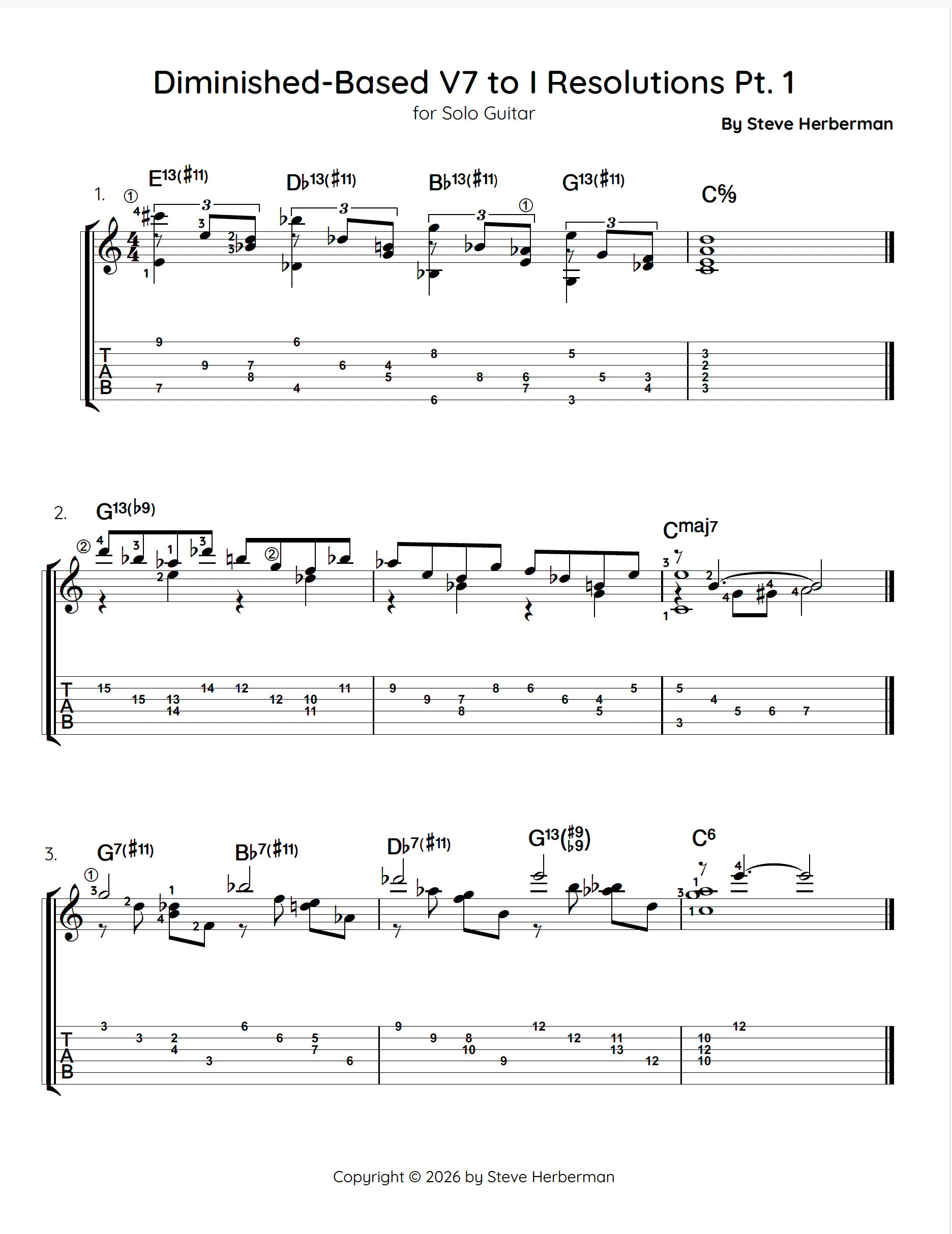
Example 1 has an E bass note and over beat 1 an E13#11 is formed gradually. While the outside two notes E (root) and C# (13) are sounded, the last part of beat 1 includes a #11 and b7. I refer to this as a “gradual chord” built over time, in this case just one beat. The chords move down 3 frets at a time (in minor 3rd intervals) and resolve into the C6/9 smoothly.
Example 2 begins with two single notes on adjacent strings that can be blended together to form a dyad. Then on beat two a C# minor triad is formed, all notes in the G7 half whole scale which are the following notes: G, Ab, Bb, B, C#, D, E and F. This pattern on the 1st two beats is repeated going down in minor 3rds. The fingerings repeat as well. In the third bar we resolve to a Cma7 using a major 10th interval to start. It’s quickly followed by an added major 7thand then by a chromatic line threaded in between. Another gradual chord.
Example 3 is a descending phrase but moves up in minor thirds every 2 beats as a chordal sequence. Starting on a G7#11 we follow the same principles as before working its way up to a resolution on a C6 chord. This contrapuntal approach to chord building sometimes has a mechanical feel to it, in fact George Van Eps called them “mechanisms.” The fretting hand fingers are doing some well-balanced mechanical movements that are precise and fun to play.
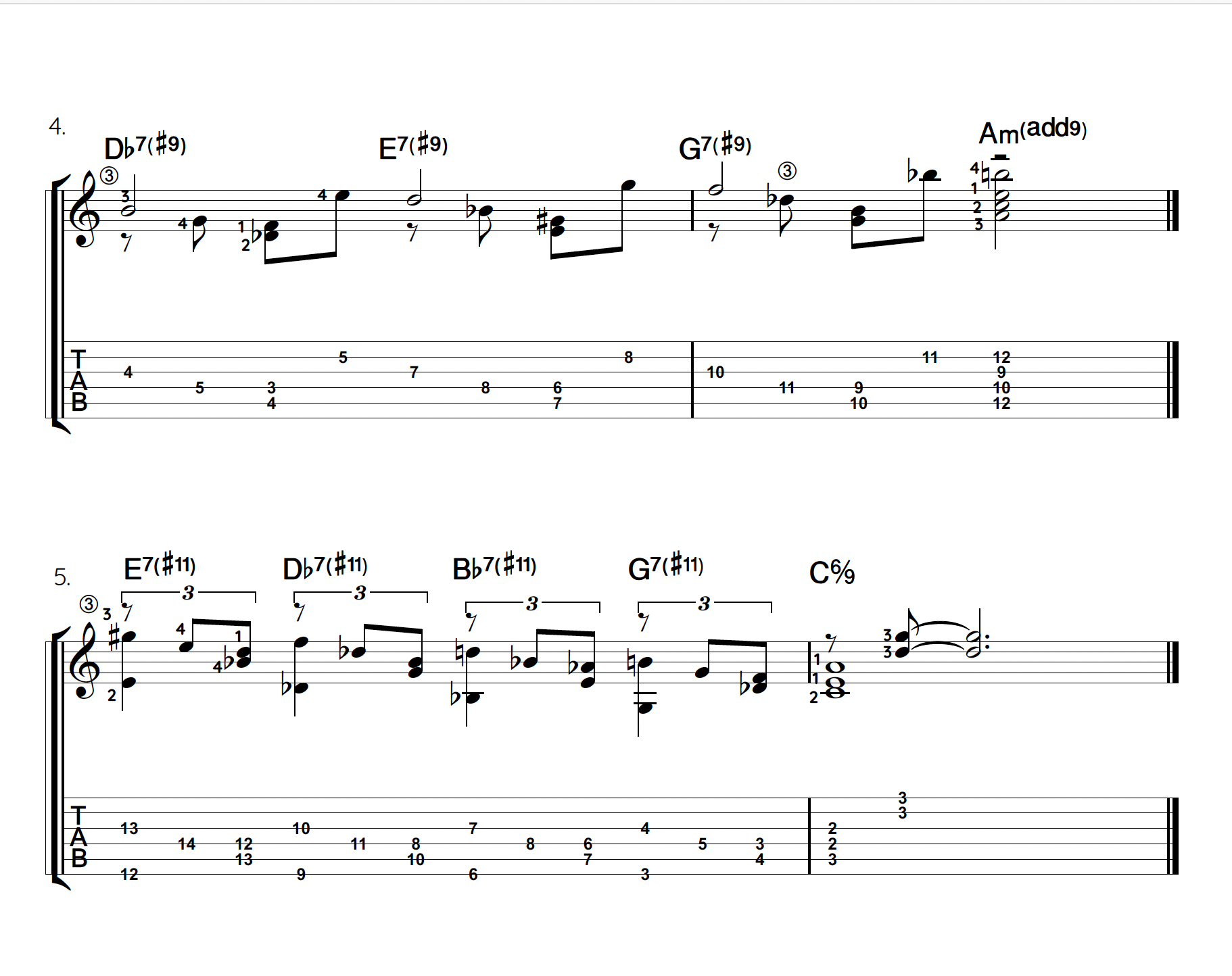
Example 4 we form a Dom7#9 chord over two beats and move that pattern up in minor 3rds resolving into the relative minor of C: A minor. The Bb note in the G7 could have moved down to an A but I prefer the sound of it moving up to a B, the 9th of the A minor chord. The V7 to VI- is nice for a change and is a bit of a surprise to the ears.
Example 5 uses all four dom. 7 chords resolving to the tonic 6/9 chord in the 2nd bar. The movements on the Dom7ths may take a little work to get cleanly. It’s a little tight starting that high up the neck and the 4th finger is dancing around a bit to get the job done. It’s a great pinky finger workout. The picking hand is also getting a good workout in these examples and may contain some wide string skips to navigate in places.
I hope these examples have given you some good ideas for some possible things to do over a V7 chord that are motivic and symmetrical. Next column we will continue with some additional examples in this style. Until then write a few of your own and as always enjoy the journey!
https://www.steveherberman.com/