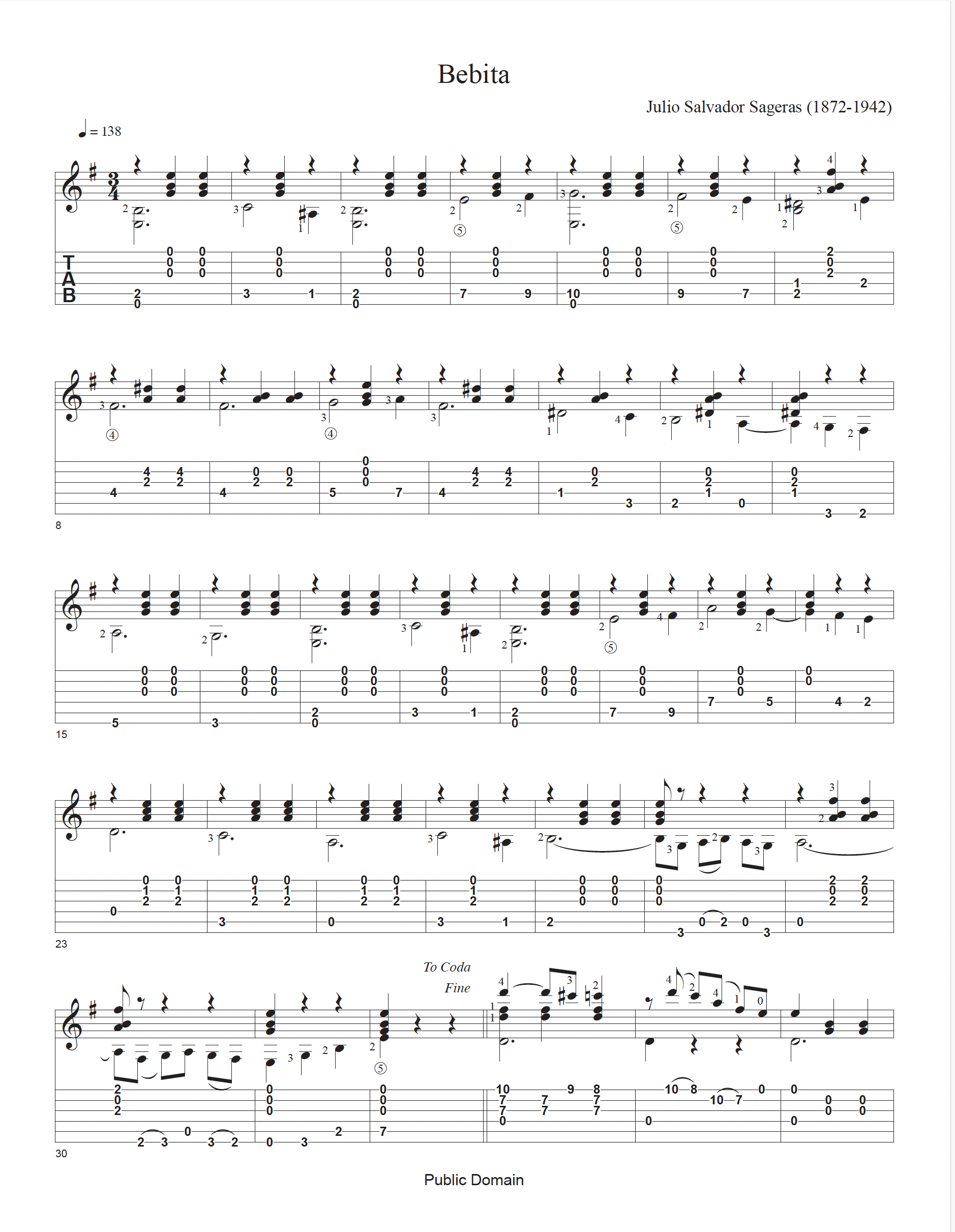
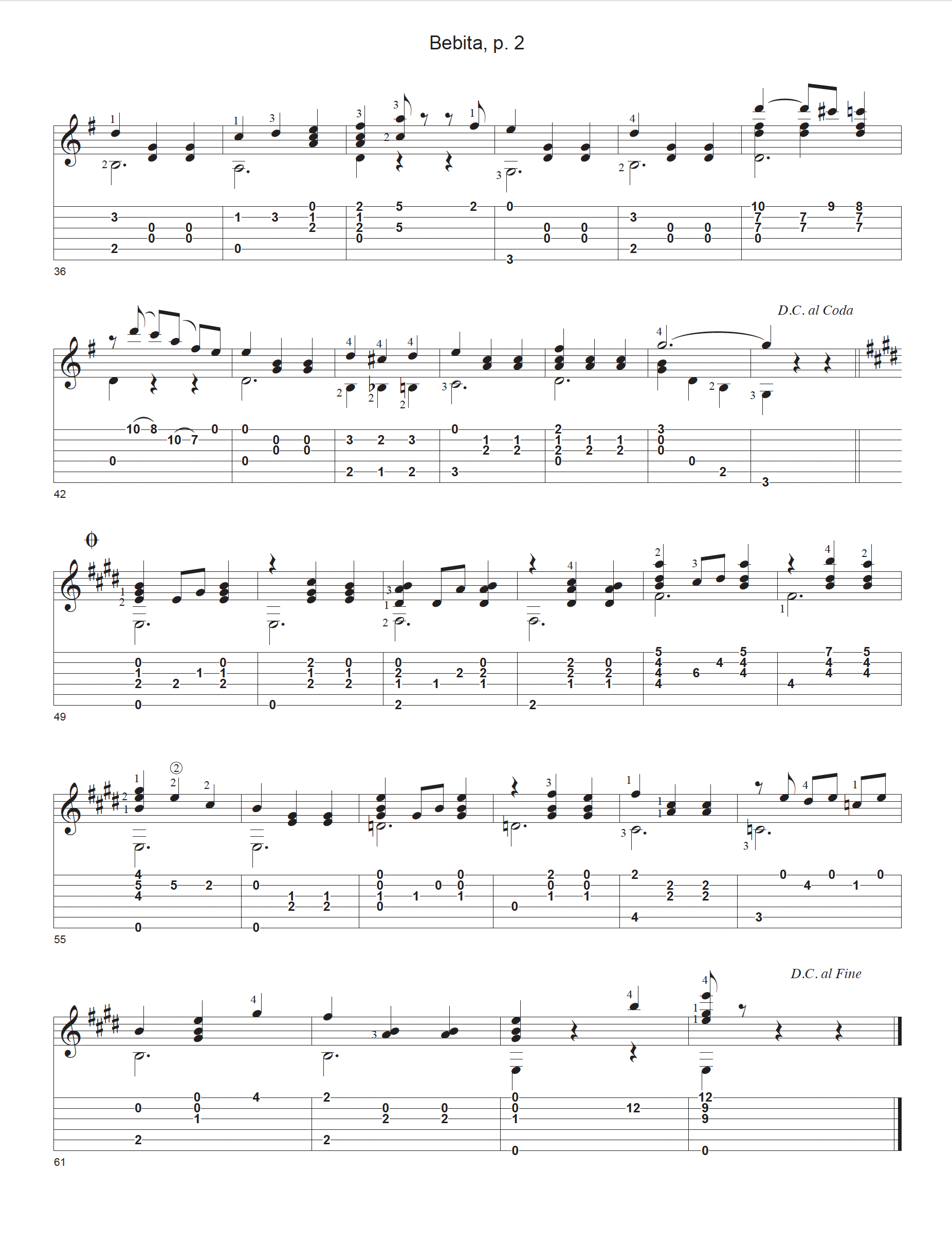
Taylor Counce - Bebita by Julio Segreras
The Segreras methods (Las Lecciones de Guitarra) are quite often one of the first things I prescribe for my students. Not only is the information intuitive, but it's careful construction of foundational principles and repetition of idioms found in many of the works of great guitar composers are integrated throughout these lessons. For any guitarist looking to expand their knowledge set and build greater fluency regarding reading music and more importantly understanding the fretboard, the works and methods of Julio Segreras are a sacred milestone. This piece in particular serves as an excellent domain to mention the historical context, application of some of these idioms, and some of my personal approaches to a comprehensive score study of the material.
“Bebita” was composed outside of these lessons as a standalone piece most associated with pieces affectionately dedicated to the women/girls in his life– Anita (Op. 32), Maria Luisa (Mazurka), and Mercedes (Op. 108). This piece was likely a personal dedication though to whom specifically is not mentioned in surviving sources.
This waltz is in a standard rondo form consistent with the salon traditions of late 19th century and early 20th century Buenos Aires. With this in mind, we can explore some of the wider practices of this style to integrate into the interpretation, while dynamics aren’t included in the score available online, we can view this as an opportunity to implement/notate discretionary dynamics into the music specifically what was considered standard during this period, a louder refrain and softer b and c sections. The biggest consideration here is CONTRAST...In fact, with most of our decisions throughout we should be balancing providing a contrast of the sections while not fighting the guitar along the way.
For this piece, we are initially confronted with an A section that includes the melody in the bass. Composers would commonly use this texture to provide a rich cello sound commonly associated with the A and D strings. Thankfully, Segreras provides us with some context on how to treat this material (Lessons no. 61-63, Book 1). In these etudes he implores the student to keep the accompaniment in the texture soft so the bass melody can cut through. This explains why most of the melody here in the A section is kept on the 5th string. While this frees up our treble for the accompaniment voicings, we also must rely on quick shifts in the left hand to maintain a beautiful legato sound in the melodic material (e.g., m. 4-5).
While on the topic of the thumb, it is also worth noting the use of what I refer to as a the “double thumb”. In the double stop of beat 1 on the first measure, we have a small strum indication commonly used to imply a double thumb, a thumb strum. This is primarily
used to add weight whereas the note on the melody (the top note of the double stop) should connect with the rest of the melodic phrase. If we have open E and B together as we do in measure 1 requiring a double thumb, we should be able to hear the B connecting with the next note in the melody in m. 2. A voice leading to C on the downbeat. I recommend practicing this on its own to achieve the correct balance. You can also find this particular idiom in other works like Etude no. 11 by Heitor Villa Lobos. While these thumb strum indications aren’t indicated throughout, I believe they are necessary to implementing much of the material in the A section (see m. 7).
While there isn’t much worth noting here with regards to slurs/ties in this piece it is worth mentioning to follow these precisely as when they do appear (bass melody- m. 28/30, B section m. 34-35) these contribute significantly to the momentum and feel of the piece overall. For guitarist less familiar with conventions of the Spanish guitar or classical guitar tradition, first off thank you for interest in the article. I hope this information is of use. These slurs are most effective when pulling the finger off the string with a snap rather than a lift. This is something I find myself mentioning to many of my students who are having difficulty with their slurs, particularly the pull-offs. The motion should be small, and we should do our best here to preserve a properly framed left-hand position. 4 fingers over 4 frets.
Connecting back with the dynamics mentioned in the introduction, I find that starting this piece with a heavier dynamic mf-f achieves two things: it complements the convention of louder refrains (A section) found in this style of music/period. It also balances the texture in section A. With a louder dynamic to support the heavy thumb, we have more headroom to play softer supporting triads in each of the measures. When we shift to the B section (m. 34), we can place more focus on a beautiful and soft “Sul Tasto” as the texture shifts to the upper register. Upon arrival at the B section, now that the texture has shifted, we must also focus on balancing our triads here throughout. These triads are primarily on the (i,m,a) fingers in the right hand, the same fingers that covered the accompaniment triads in the A section, for this contrasting B and C sections we must try and balance these triads with the top note (melody) cutting through the texture. Practicing these triads independently with a focus on the “a finger” in the right hand should help significantly.
In many of the Segreras etudes you’ll find notes that should ring for a longer duration but are only notated on one beat (e.g., m.35-36 and m. 39-40). In instances like this, many of my students’ intuition takes precedent and the problem essentially solves itself. It is worth noting here that you can let these notes ring as they are part of the melodic material. In some cases, a student would play the rhythm appropriately, resulting in a slightly disconnected melody. This highlights the importance of knowing where the melody sits in the texture so you can make informed decisions on how you want to play it. Singing the melody never fails! My philosophy with this is that I would rather a student make an intentional decision (with written notes in the score) rather than overlook a detail like this altogether. Having a pencil handy when practicing is an important habit to build. No pens!
In conclusion, it’s important to note here that I touched on all these considerations not to overwhelm but to impress the fact that many of the works by Segreras are saturated with rich historical idioms and technical considerations with explanations that are easy to source online. It’s quite an enjoyable process to uncover these details through score study. This is where the rubber meets the road with regard to mindful development on our instrument. As a guitarist, applying this level of detail across all styles/genres will provide you with the awareness to capitalize on the ample opportunities given to make informed performance and compositional decisions for the guitar. Happy Practicing!
References:
Sagreras, Julio S. Guitar Lessons: Books 1-3. Edited by Matanya Ophee, translated
by Colin Cooper, Mel Bay Publications, 1996.
Sagreras, Julio S. Bebita: Tango para Guitarra. Heidelberg: Chanterelle Verlag, 1985.